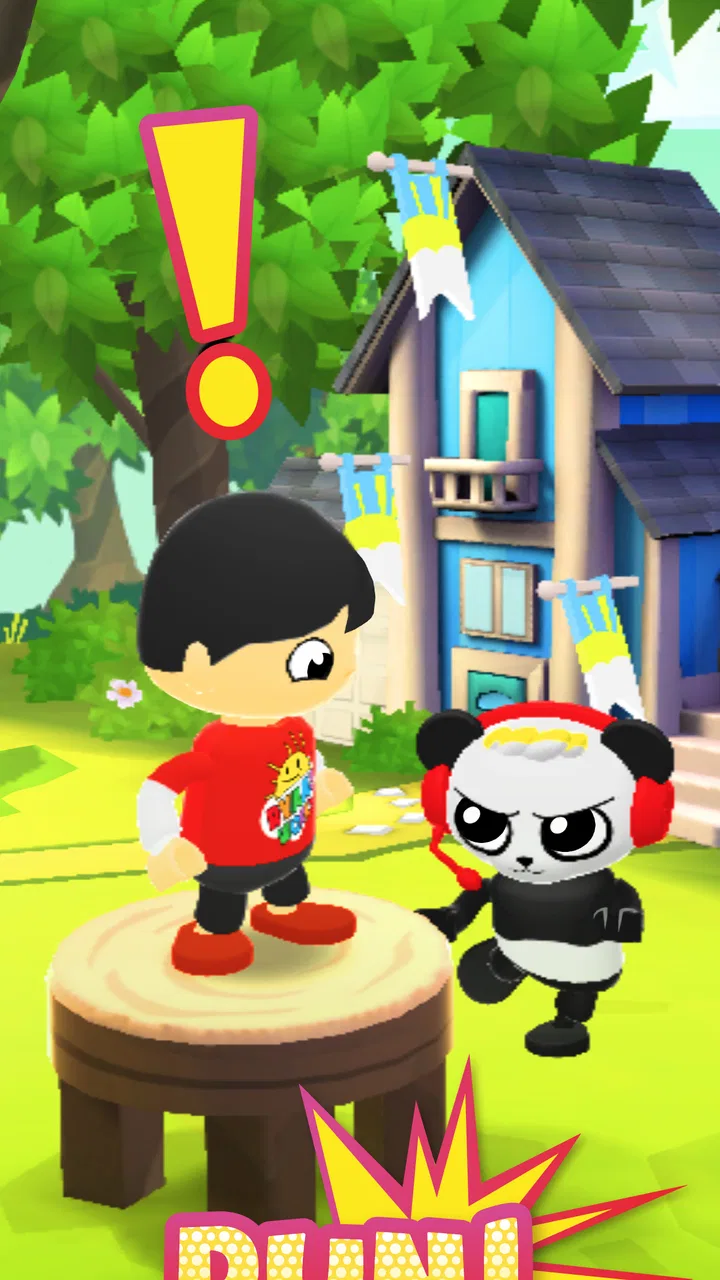
Tag with Ryan
- 3.8
- Rating
- 10.00M
- Installs
- Free
- Price

 Analysis by App-foxy
Tag with Ryan is a casual game built around a very simple idea: become Ryan from Ryan’s World and keep going while the action stays manageable. I found it easy to understand within moments, which is exactly what I want from a game aimed at quick, relaxed play. It is free to download, carries an Everyone age rating, and comes from WildWorks, so its strongest appeal is clearly accessible entertainment rather than a complicated system designed for dedicated players.
That simplicity is both its charm and its main challenge. You do not need a long tutorial or prior knowledge of competitive games to begin. At the same time, players who expect deep progression, carefully balanced strategy, or a large variety of modes may reach the limits of the experience sooner than they would with a larger casual title. My impression is that it works best as a short-session game for fans of Ryan’s World and families looking for something immediately approachable.
How the everyday gameplay loop feels
The baseline workflow is refreshingly direct. I open the game, start a run, focus on the immediate action, and try to continue for as long as possible. That makes it suitable for small gaps in the day: a few minutes while waiting, a quick break between tasks, or a simple game to hand to a child who does not want to learn a complicated control scheme.
You May Also Like

 Blood Strike: 2.5 Anniversary
Blood Strike’s Loadouts Turn Every Drop Into a Tactical Gamble
A close look at Blood Strike’s custom loadouts: how fast access to signature weapons reshapes its battle royale rhythm, rewards preparation, and narrows the gap between fights.

 Pandora - Music & Podcasts
Pandora’s Music Is Easy to Start, but Harder to Recover
Pandora’s strength is its low-effort path from a seed to a station. Its weak spot is how much confidence it asks you to place in connection, setup, and quiet recovery.

 8 Ball Pool
 Is Built on Rivalries, Rematches, and Routine
A close look at the rivalries, rematches, shared routines, and unanswered safety questions that turn a quick pool match into a persistent mobile community.

 Samsung Music
’s Quiet Strength Is Playing What You Already Own
Its reach comes less from spectacle than from dependable access to a personal library. That simplicity is both the app’s strongest retention engine and its ceiling.

 AccuWeather: Weather Radar
AccuWeather Review: A Quick, Clear Forecast for Everyday Decisions
For everyday plans, the best forecast is the one you can understand quickly. AccuWeather makes rain timing, radar, and local conditions easy to act on, with a few trade-offs.

 Hill Climb Racing
Why Hill Climb Racing Still Turns Crashes Into One More Run
A tiny car, a bumpy hill and one more upgrade: Hill Climb Racing keeps resurfacing because its simple chaos makes every near-miss feel personal.
More From Our News Desk



The important habit is to treat each attempt as a short practice session rather than expecting every run to be a major achievement. Early play is useful for learning how the game responds and for recognizing the rhythm of movement. Once that becomes familiar, I pay less attention to the character and more attention to what is about to appear next. That shift helps avoid rushed reactions, especially when the screen becomes busier.
I also recommend keeping the first few sessions deliberately calm. It is tempting to move constantly or react to every visual element, but casual games often reward consistency more than frantic input. With Tag with Ryan, a steady pattern makes it easier to understand whether a mistake came from timing, positioning, or simply losing concentration. That is a more useful way to improve than repeatedly restarting without noticing what went wrong.
For a realistic everyday scenario, imagine giving the game to a child during a short car journey or letting a younger player try it while an adult is nearby. The controls and objective are simple enough to explain in ordinary language, and the game can be enjoyed without turning the session into a long lesson. I would still keep an eye on how long the session lasts, because the bright, repeatable action can encourage “one more try” even when the player is becoming tired.
What makes the simple format work
The game’s recognizable Ryan theme gives the basic action a clear identity. A generic endless casual game can feel interchangeable, but here the character connection is the reason many players will choose this particular title. That matters most for children who already know Ryan’s World and enjoy seeing a familiar figure in an interactive setting.
For adults choosing a game for a family device, the Everyone rating makes the intended audience immediately clear. That does not mean every child will enjoy it equally, but it does make the game easier to consider for shared use than a title built around frightening imagery, complex combat, or mature subjects. I see it as a light entertainment option, not as an educational tool or a substitute for creative play.
The current version is 1.37.0, and the game supports devices running Android 7.0 or later. Those details are useful when deciding whether an older phone or tablet can handle installation. I would check the operating system before planning a family session, particularly if the device has been kept for several years. Compatibility is a practical issue here because a child may be ready to play before anyone has remembered that the device needs an update.
Settings and habits worth checking first
Experienced use starts with a small preparation routine. Before handing over the device, I check the phone’s general sound level, notification behavior, and available space. These are not special features of the game, but they make a real difference to a short-session title. A sudden notification can interrupt concentration, while a very loud device can make an otherwise harmless game annoying in a quiet room.
I also look at the game’s available settings on the device and in the title itself, using only options that are visibly offered rather than assuming there are hidden controls. If a player finds the action too fast, the better response is usually to adjust the playing environment and take shorter attempts, not to search for an advanced mode that may not exist. Keeping expectations realistic prevents a lot of unnecessary frustration.
Because the game is free, it is worth discussing purchases before a child begins playing. Optional items range from $0.99 to $49.99 each, so I would not leave a young player unsupervised with a payment method attached to the device. My practical routine is to use the device’s purchase restrictions, explain that the free download does not mean every item inside the game is free, and decide in advance whether any purchase is acceptable. This conversation is more useful than treating the price of the download as the whole cost question.
That purchase range also changes how I judge the game. I am comfortable recommending it as a free starting point, but I would not describe every optional item as necessary for enjoying the core experience. A player who wants only a quick casual distraction can begin without spending money. Someone who is strongly motivated by collecting or customization should first decide whether those extras genuinely improve the experience before buying them.
Faster patterns for improving without overthinking
My most useful shortcut is to create a repeatable opening routine. I begin each attempt with the same relaxed posture, keep the device at a comfortable distance, and avoid changing grip halfway through. This sounds minor, but inconsistent handling can make a simple game feel harder than it is. A stable setup lets me judge the game’s timing instead of constantly adjusting how I hold the phone.
A second habit is to use short review pauses. After a failed attempt, I ask one question: what was the first decision that put me in trouble? If the answer is clear, I change only that behavior on the next run. If I try to correct everything at once, the result becomes difficult to interpret. This one-change approach is especially useful for younger players because it turns failure into a small, understandable experiment.
I find it helpful to separate “score chasing” from “learning runs.” During a learning run, I focus on seeing what comes next and keeping control. During a score attempt, I use the same motions but avoid unnecessary experimentation. Mixing those purposes can make a player impatient. Keeping them separate gives the game a little more structure without making it feel like homework.
Another practical pattern is to stop after a clear mistake rather than continuing automatically through a frustrated attempt. In a casual game, restarting immediately can feel efficient, but a short pause often produces better results. I put the device down for a moment, identify the missed cue, and return with a specific correction in mind. That is a more reliable improvement method than simply playing faster.
These habits are not secret mechanics, and I would be wary of anyone promising a hidden shortcut that transforms the game. The real advantage comes from reducing careless input and making each attempt intentional. That is where experienced play differs from random repetition: the player builds a routine around the game’s simplicity instead of demanding complexity from it.
Where the game is a good fit—and where it is not
Tag with Ryan is a good fit for a child or fan who wants familiar characters, immediate action, and a game that can be understood without reading a long explanation. It also suits adults looking for a low-pressure title to share briefly with a younger player. The casual category is accurate: the game is easy to pick up, and its appeal comes from repeating the central challenge rather than mastering a large collection of systems.
I would be more cautious about recommending it to someone who wants a deep long-term game. If your preferred casual titles offer puzzles, story chapters, extensive customization, or several distinct modes, this may feel narrow by comparison. A more feature-rich alternative would be better for a player who needs constant novelty or wants meaningful strategic choices in every session.
It is also not the best choice for a household that wants a completely purchase-free environment without adjusting device controls. The free entry point is convenient, but the presence of in-app items means parents should establish boundaries before play begins. That is not a reason to reject the game, but it is a reason to treat installation and supervision as part of the setup.
The average rating is 3.8 from around 107,000 ratings, with about 15,000 written reviews. I read that as a sign of a recognizable but not universally satisfying experience: plenty of players are interested enough to try it, while the middling average suggests that the straightforward format will not work equally well for everyone. Its reach is substantial, with over 10 million installs, but popularity does not change the central trade-off between accessibility and limited depth.
The advanced limits you should understand
The biggest advanced limitation is that there is only so much room to optimize a deliberately simple game. Better timing and calmer reactions can improve performance, but they cannot turn the title into a strategy game. Once a player has learned the basic rhythm, progress may begin to feel more like polishing execution than discovering new ways to play.
That can be positive for a younger player who enjoys repetition and recognizable goals. It can be less satisfying for an older player who expects each session to reveal new mechanics. I would therefore judge the game by the kind of mastery it offers: it is about consistency, attention, and keeping a run going, not about building a complex plan or managing a large set of resources.
There is also a social limit. The experience is easy to share informally—someone can watch, offer timing advice, or take a turn—but I would not choose it as the main game for a group that wants elaborate multiplayer competition or a long cooperative session. Its strength is the immediate personal challenge, and that focus should be clear before downloading it for a party or family gathering.
For storage and compatibility, the practical checks are straightforward. Android users should be on at least version 7.0, and anyone using an older device should confirm that the game installs and runs comfortably before promising it to a child. On iOS, I would use the same general principle: check the device’s current support and keep the operating system reasonably up to date. The important point is to test the actual family device rather than assume that every older phone will behave identically.
I also recommend deciding on a session boundary. A timer, a fixed number of attempts, or a clear stopping point works better than waiting until the player becomes annoyed. Since the gameplay encourages repeated tries, a boundary protects the fun part of the experience. This is particularly useful when the game is being used as a brief distraction rather than as the main activity.
My verdict after settling into the routine
After using it as intended, I see Tag with Ryan as a friendly, accessible casual game whose best quality is how quickly it gets out of the way and lets the player act. The Ryan’s World connection gives it a clear audience, while the uncomplicated structure makes it suitable for short sessions and shared family use. WildWorks has kept the concept easy to understand, which is exactly why it can work for younger players.
My recommendation depends on what you want from the download. If you are looking for a free introduction to a familiar character, a quick game for waiting time, or a simple challenge that a child can learn without much help, I think it is worth trying. Start without spending money, check the device and purchase controls, and use short attempts to see whether the central loop holds your attention.
If you want a broad collection of modes, a substantial story, or a game that keeps revealing new strategic layers, I would choose a different casual title. This one is at its best when its limits are treated as part of the design rather than as promises it failed to keep. The smartest way to play is to keep the setup simple, make each attempt purposeful, and decide early whether repetition feels satisfying to you.
In the end, I would recommend Tag with Ryan mainly to Ryan’s World fans and families seeking uncomplicated entertainment. It is free to start, rated for Everyone, and easy to fit into everyday moments. Just keep the optional purchases in mind, avoid expecting advanced depth, and give the game a fair trial through a few focused sessions instead of judging it after one hurried attempt.
FAQs for Tag with Ryan
01What is Tag with Ryan?
Tag with Ryan is a colorful endless-running game based on the popular Ryan’s World character. Players guide Ryan through different worlds, collect coins, avoid obstacles, and try to achieve the highest possible score. The controls are designed to be simple, using swipes to move, jump, or change lanes, making the game accessible for younger children while still offering a fast-paced challenge.
02Is Tag with Ryan suitable for children?
The game is primarily designed for children and fans of Ryan’s World, with bright graphics, familiar characters, and straightforward gameplay. However, parents should still review the available settings and store information before downloading. As with many free mobile games, children may encounter advertisements, optional purchases, or prompts that require parental supervision, especially when playing on a shared device.
03Does Tag with Ryan require an internet connection?
Tag with Ryan may be playable without a constant internet connection, which is useful for short trips or areas with limited service. Nevertheless, certain features can depend on connectivity, including advertisements, updates, account-related services, or promotional content. It is a good idea to launch the game once while online and check its behavior before relying on offline play.
04Is Tag with Ryan free to download and play?
Tag with Ryan is generally offered as a free download, allowing players to start running and collecting rewards without paying upfront. The free version may include advertising and optional in-app purchases, such as extra items, bonuses, or other content. Parents should check the payment settings on the Android or iOS device and enable purchase restrictions if necessary.
05What devices are compatible with Tag with Ryan?
Compatibility depends on the version available in the Google Play Store or Apple App Store, as well as the operating system installed on your device. Most recent Android phones and iPhones should run the game, but older devices may experience slower performance, limited storage, or installation restrictions. Always check the current store requirements before downloading.
Pros
- Bright
- colorful visuals appeal to younger children.
- Simple controls make the game easy for preschoolers to understand.
- Familiar Ryan-themed characters add extra appeal for fans.
- Short activities are suitable for quick play sessions.
- Rewards and animations help keep children engaged.
Cons
- Some content may feel repetitive after extended play.
- The app may be too easy for older children.
- Frequent animations can be distracting for sensitive users.
- Parents should check in-app purchase and ad settings.
- Device storage and performance requirements may vary.

Tag with Ryan
Gallery